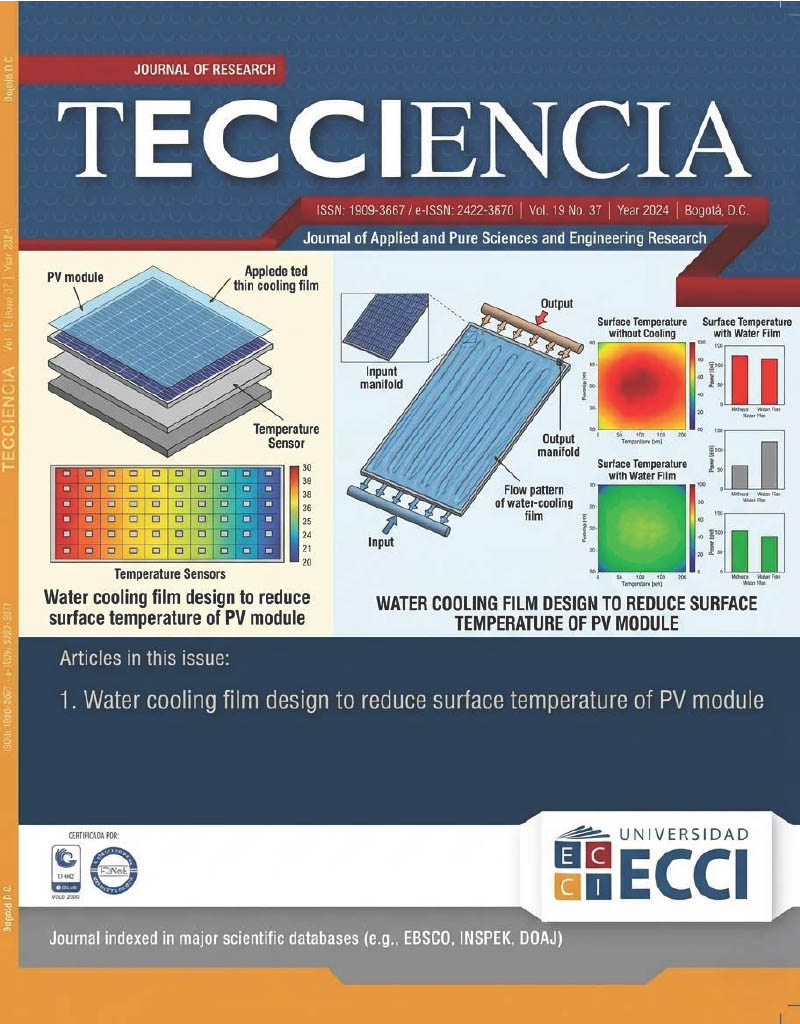
Water cooling film design to reduce surface temperature of PV module
DOI:
https://doi.org/10.18180/tecciencia.2024.37.1Keywords:
PV Module Efficiency, water film thickness, optimum Reynolds number, CFD Analysis, temperature reductionAbstract
Solar energy is the most available solution being used worldwide but at present the commercial Photovoltaic (PV) module is only limited to 19% efficiency, this efficiency is further reduced to 10-16% due to rise in temperature at the mid-day time. Current study focuses on the reduction of the temperature of the PV module by using CFD analysis using water at the front surface of the PV module. For the simulation front glass specifications are considered with laminar flow of water. Different thickness of water film and varying Reynolds number has been analyzed. In this regard, 10 Reynolds number ranging from 5 to 50 and 10 different thicknesses ranging from 5mm to 50mm were studied. It was concluded that the maximum change in temperature was at the water film thickness of 5mm and Reynolds number 10.