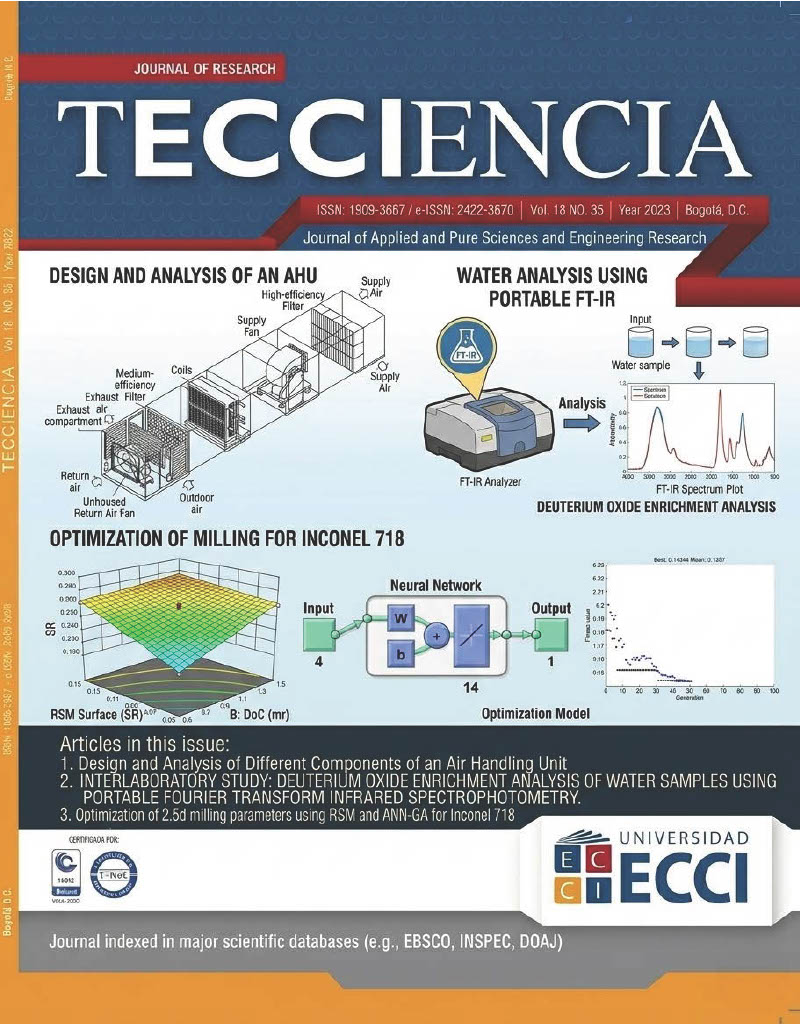
Optimization of 2.5d milling parameters using RSM and ANN-GA for Inconel 718
DOI:
https://doi.org/10.18180/tecciencia.2023.35.3Keywords:
inconel 718, RSM-BBD, surface roughness, 2.5d milling, artificial neural network, genetic algorithmAbstract
For the manufacturing of thin-walled-complex-shaped components used in complex dies and moulds it is important to manufacture these kinds of components with hard, tough, and heat-resistant materials such as Inconel 718. During the end milling of such types of components, there are many challenges related to surface roughness, tool wear, etc., identified in the recent past. Therefore, in this study, a prediction model for surface roughness with respect to the input parameters such as cutting speed, Depth of Cut, Feed rate and nose radius has been developed. In the present work, an attempt has been made to develop a prediction model of SR during milling of Inconel 718 with the help of BBD-RSM-Regression as well as ANN. Besides this, a comparative analysis has been conducted among these techniques, and it has been observed that the AI technique provides better prediction than the BBD-RSM-Regression. The ANOVA technique is also applied to find an estimate of the percentage contribution of each machine parameter with respect to machine time. Further, GA is used for the purpose of effective optimization. Five structural trials have also been conducted to validate this novel strategy, which has been proven to be more successful.